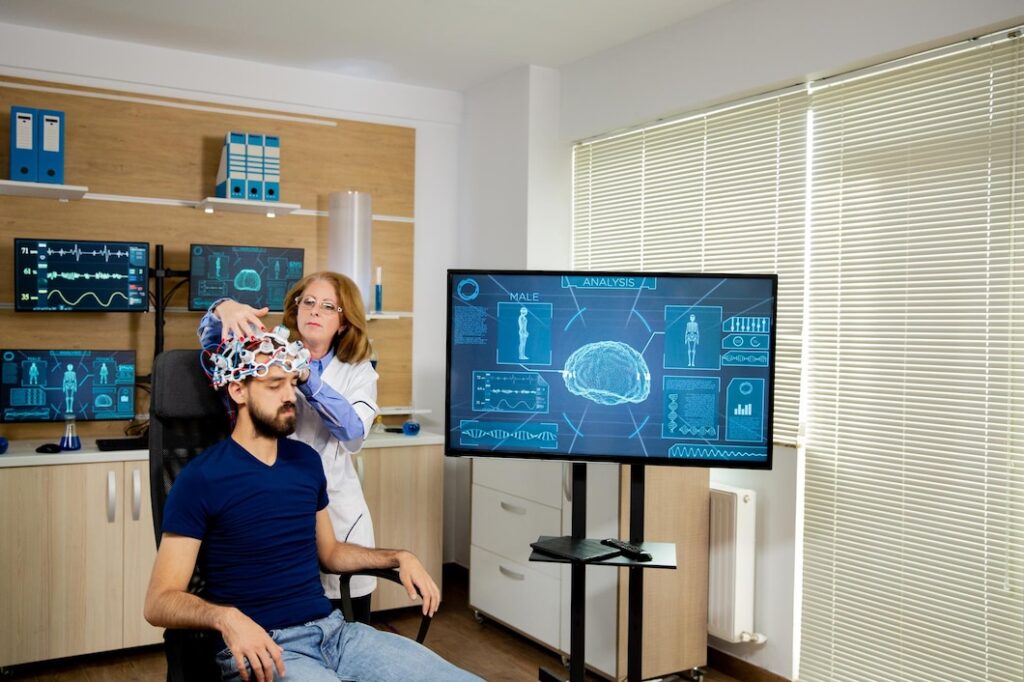
Across healthcare systems globally, AI has moved from pilot projects into the operational core of mental health delivery. Providers are now deploying machine-learning models to detect early warning signs of distress, predict disengagement, and dynamically allocate limited clinical resources where they are needed most.
This is a structural shift—not a technological experiment.
AI systems analyze patterns across appointment behavior, message tone, response latency, symptom reporting, and digital engagement to surface risk before crisis becomes visible. Instead of waiting for men to self-identify or reach a breaking point, systems are beginning to notice first.
Why This Matters for Men
Men are statistically less likely to:
- initiate mental health care
- verbalize emotional distress early
- remain engaged once friction appears
AI changes the equation by reducing reliance on self-disclosure as the primary signal.
When systems can detect risk through behavior rather than confession, men are more likely to receive support without having to ask for it explicitly. This is especially critical in moments where pride, stigma, or uncertainty delay help-seeking.
From a MENTECH perspective, this represents a fundamental realignment: care begins responding to how men actually behave, not how systems wish they would behave.
From Reactive to Proactive Mental Health Care
Traditional mental health operations are reactive:
- patients reach out
- symptoms escalate
- resources respond late
AI-enabled operations reverse this sequence.
By continuously monitoring engagement signals, systems can:
- flag men at risk of disengagement
- prioritize outreach to those showing early deterioration
- match intensity of care to actual need, not volume of requests
This allows clinicians to intervene earlier, with lighter, more effective touchpoints—often preventing escalation altogether.
A Conscious Shift in How Support Is Delivered
What makes this shift powerful is not speed alone, but attunement.
AI does not replace human judgment—it augments awareness. It allows clinicians to see patterns across time and context that no single provider could track manually. This creates a form of systemic sensitivity: the ability to notice strain before it hardens into pathology.
For men, this reduces the internal burden of deciding when something is “bad enough” to justify reaching out. The system meets them halfway—sometimes more than halfway.
Benefits of AI-Driven Mental Health Operations
For men
- Earlier support before crisis or shutdown
- Reduced need for self-advocacy
- Fewer missed warning signs during disengagement
- Care that adapts to behavior, not labels
For clinicians and systems
- Smarter triage and prioritization of scarce resources
- Reduced clinician burnout through better workload distribution
- Improved outcomes with fewer emergency escalations
- More sustainable mental health delivery at scale
When systems recognize patterns early, pressure is released across the entire ecosystem.
MENTECH Context: Intelligence That Notices Before Collapse
MENTECH interprets this evolution as a necessary maturation of care systems. Mental health improves not only when interventions are available, but when systems are perceptive enough to respond in time.
AI enables this perceptiveness. It allows care to function as an adaptive process—tracking strain, responding proportionally, and restoring balance before breakdown occurs.
This is not surveillance.
It is responsiveness at scale.
Why This Will Define the Next Phase of Mental Health Care
As demand for mental health services continues to outpace workforce capacity, reactive models will fail. AI-driven operations offer a way forward—not by replacing clinicians, but by making their attention more precise and humane.
For men—who often suffer quietly, disengage early, or appear “fine” until they are not—this may be one of the most impactful shifts in modern healthcare.
Care that notices early saves lives.
Care that adapts sustains engagement.
Care that responds intelligently restores trust.
Reference
- Mental health AI is breaking through into core operations
Healthcare IT News
https://www.healthcareitnews.com/news/mental-health-ai-breaking-through-core-operations-2026
Read about: AI Is Transforming Healthcare at Large — And Men Benefit Too