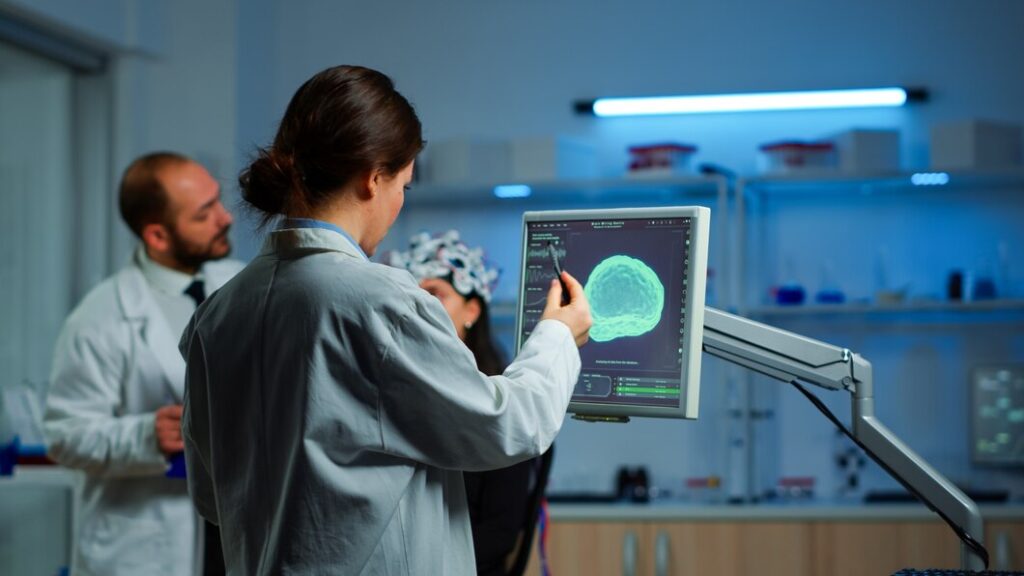
One of the most consequential innovations reshaping men’s health in 2025–2026 is the rise of AI-powered diagnostics and personalized screening pathways. Across cancer care and chronic disease management, advanced imaging combined with machine learning is enabling clinicians to detect risk earlier, interpret signals faster, and tailor decisions to the individual rather than the average.
For men—who historically delay routine screening—this shift is not incremental. It is structural.
AI systems now analyze complex data streams (imaging, biomarkers, longitudinal health records) to surface subtle changes that traditional methods often miss or catch too late. In prostate cancer, for example, AI-assisted MRI interpretation is accelerating diagnosis timelines and improving accuracy, reducing both false negatives and unnecessary invasive procedures.
Why This Matters for Men—Beyond Early Detection
Men often postpone screening due to:
- uncertainty about when to start
- fear of invasive follow-ups
- lack of clear, individualized risk context
- friction in navigating appointments and results
Personalized, AI-supported screening changes the experience at its root. When risk is contextualized to the individual, screening becomes informative rather than alarming. When interpretation is faster and clearer, follow-through improves.
From a MENTECH perspective, this is critical: men engage when systems replace ambiguity with orientation.
From One-Size-Fits-All to Risk-Aware Care
Traditional screening models are population-based. AI-enabled diagnostics are pattern-based.
This means:
- screening intervals adapt to personal risk rather than age alone
- imaging results are interpreted in context, not isolation
- follow-up decisions are proportional, not automatic
The result is a calmer, more precise pathway:
- low-risk men avoid unnecessary procedures
- high-risk men are escalated earlier
- clinicians spend time where it matters most
This precision reduces both over-treatment and under-detection—two long-standing problems in men’s health.
A Conscious Shift: Detection as Guidance, Not Fear
A subtle but powerful change accompanies AI diagnostics: the emotional tone of screening.
When results arrive faster and with clearer explanation, screening shifts from a moment of dread to a moment of insight. Men are less likely to disengage when detection feels like guidance rather than judgment.
This matters because fear-driven avoidance is one of the biggest barriers to men’s preventive care. AI does not remove fear—but it shortens uncertainty, which is often the most destabilizing part.
Benefits of Personalized, AI-Driven Screening
For men
- Earlier, more accurate detection
- Reduced anxiety through faster clarity
- Fewer unnecessary tests and procedures
- Greater trust in screening as a supportive process
For health systems
- Lower late-stage disease burden
- More efficient use of specialist resources
- Improved outcomes through earlier intervention
- Better alignment between data, decision-making, and care delivery
For long-term health
- Increased uptake of routine screening
Better survival and quality-of-life outcomes - A shift from crisis treatment to preventive stewardship
When detection is precise and timely, action becomes easier.
MENTECH Context: Intelligence That Restores Orientation
MENTECH views personalized screening not simply as better technology, but as a rebalancing of how health information is delivered and experienced.
When systems:
- interpret signals in context
- respond proportionally
- communicate clearly and quickly
men no longer have to decide whether something is “serious enough” to act on. The system helps make that determination—supporting agency without demanding expertise.
This is how prevention scales: not by urging men to care more, but by making care easier to engage with.
Why This Trend Will Define the Next Decade
As AI becomes embedded in routine diagnostics, personalized screening will move from innovation to expectation. For men’s health—where delayed detection has historically driven poorer outcomes—this shift may prove transformative.
Earlier detection saves lives.
Clearer interpretation sustains engagement.
Personalized insight builds trust.
Together, they change the trajectory of men’s health.
Reference
- NHS artificial intelligence (AI) trial to diagnose prostate cancer up to a month faster
NHS England, October 28, 2025
https://www.england.nhs.uk/2025/10/nhs-artificial-intelligence-ai-trial-to-diagnose-prostate-cancer-up-to-a-month-faster/
Read about: SMS & AI Assistants Support Mental Wellbeing Between Visits